concepts · updated 2026-08-01
Cool Cell architectural climate-control
confidence: high volatility: cold verified: 2026-08-01fresh
Cool Cell™ is Zomeworks Corporation's passive climate-control system: water reservoirs in the ceiling connect to roof-mounted radiator/absorbers. In summer, the water absorbs interior heat during the
Cool Cell™ is Zomeworks Corporation’s passive climate-control system: water reservoirs in the ceiling connect to roof-mounted radiator/absorbers. In summer, the water absorbs interior heat during the day and radiates it to the night sky. In winter, a pump circulates water through the same roof panels for solar gain. No electricity for cooling, no refrigerants, no compressor.
How it works
The system grew out of 31 years of passive-energy product development and earlier Cool Cell variants using custom-molded polyethylene bottles, five-gallon water bags, and two-liter soda bottles. The architectural brochure (circa 2002) describes five operating modes:
- Summer day: Water in the ceiling acts as a heat sink, absorbing interior heat. Roof-mounted radiator/absorbers are too hot from the sun for thermosiphon circulation — no solar gain enters the system.
- Summer night: Radiator/absorbers cool by radiation to the sky; thermosiphon circulation begins and continues overnight, recharging the ceiling reservoir with cool water.
- Winter day: A low-power pump circulates water through the roof for solar gain. Closing aluminum louvers allows maximum heat storage without overheating the space.
- Winter day with south-wall absorber: For colder climates, a south-wall absorber circulates by natural thermosiphon (no pump). Since it sits below the ceiling reservoir, it cannot drain back and must be freeze-tolerant.
- Winter heating only: In mild-summer climates, a freeze-tolerant south-wall absorber provides heating by thermosiphon with no pump.
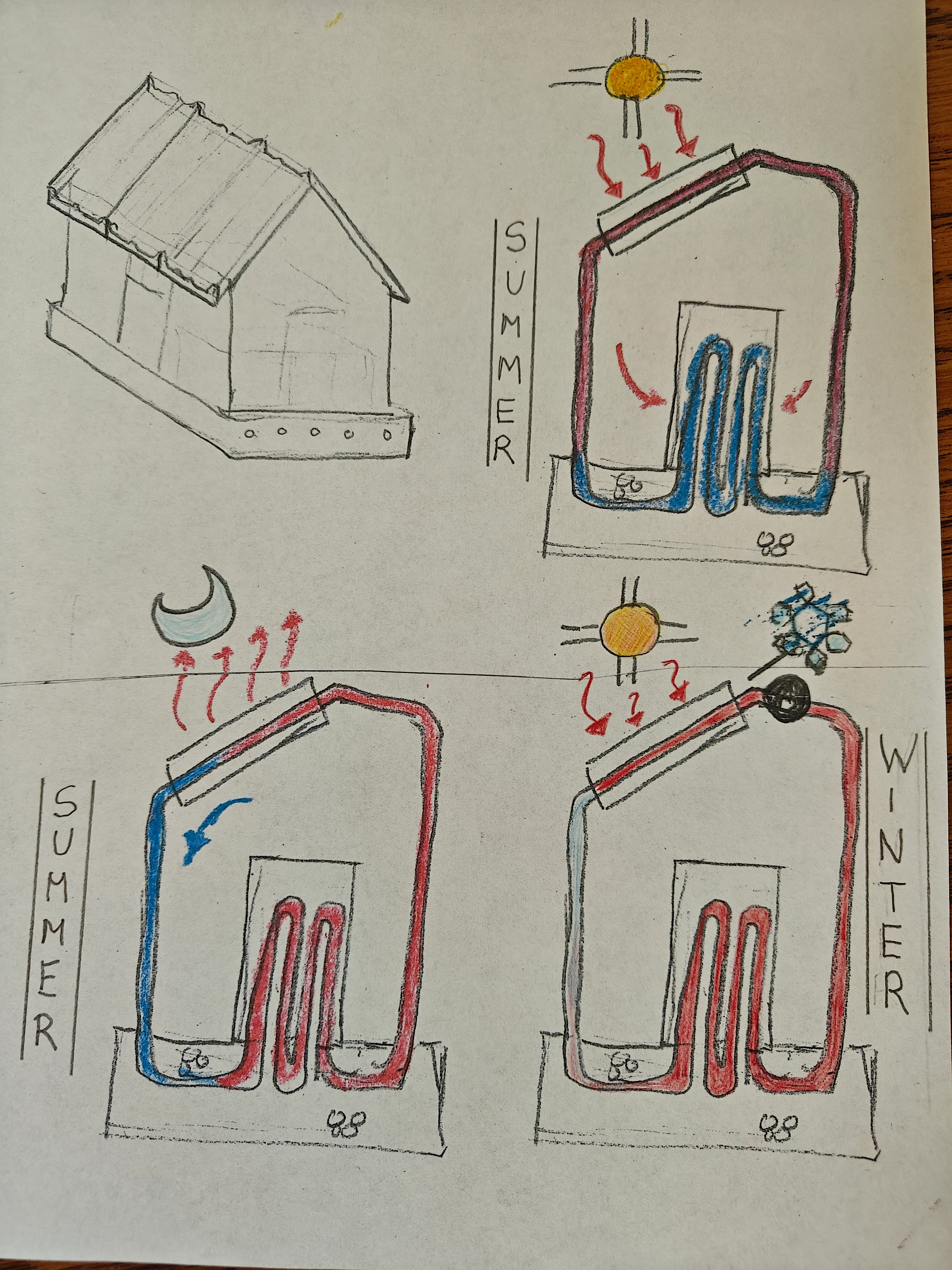
Conceptual sketch of the Cool Cell’s seasonal operating modes. Top right: summer day — sun drives roof temperature too high for circulation; ceiling tank absorbs interior heat. Bottom left: summer night — roof radiates to sky, thermosiphon recharges tank with coolth. Bottom right: winter — sun drives circulation through roof collector into storage tank.
Climate and overhead storage
The brochure is explicit about where the system belongs: “Cool Cell systems work best in dramatic climates such as the West and Southwest of the United States, where cool nights divide hot days and winter is sunny.” Colder climates need the south-wall absorber, glazing, or selective surfaces. The rationale for putting the storage overhead comes from Norman Saunders (as explained in Bill Shurcliff’s Super Solar Houses): in summer warm air rises to the ceiling mass and cool air returns; in winter heat descends by radiation and — unlike Trombe walls, drum walls, direct gain, or radiant floors — the louvers make the heat flow controllable rather than automatic. Opening the louvers doubles or triples the radiant flux.
Why water
The brochure makes the case directly: water weighs half as much as masonry and stores twice the heat per volume. It is non-toxic, non-flammable, readily available, dense, thermally conductive, and has high specific heat. Its high heat of vaporization allows “supercharging” cooling by evaporation from a wet radiator. The downside — high heat of fusion and expansion on freezing — is managed by drain-back in winter rather than antifreeze.
Development history
The battery-cabinet patent series (1989–1997) and the October 2002 “Work Leading Up” notes trace the engineering path:
- US Patent 4,913,985 (1990) — Battery Temperature Regulation System: The first patent in the Cool Cell lineage, designed for telephone company battery cabinets. A flat radiator above a water container in the cabinet; water circulates by thermosiphon. Zomeworks sold thousands of these units, commercially proving the night-sky radiative cooling principle before attempting the architectural market.
- US Patent 5,070,933 (1991) — Temperature Regulating System: Added an insulation layer inside the water container that stratifies cool/warm water — cold night-cooled water stays at the top, warm room-temperature water stays at the bottom. This is the ceiling-mounted insulated water container that became the Cool Cell ceiling reservoir concept.
- US Patent 5,316,872 (1994) — Passive Cooling System: Moved the radiator definitively to the exterior/roof of the enclosure, with symmetric parallel conduits creating balanced thermosiphon flow. The “pair of symmetric conduits” visible in the Cool Cell diagrams traces directly to this patent.
- US Patent 5,513,696 (1995): The corrugated-roof version for buildings — a system of blow-molded plastic containers with a corrugated heat-exchanger portion that mates directly to roll-formed metal roofing. Water circulates by thermosiphon between the interior reservoir and the roof. Filed in 1995 by Baer with Zomeworks as assignee; Dave Harrison’s concurrent patent application (08/277,925), cited in it, documents his parallel water-container work at Zomeworks. The 1995 system was later refined into the 2001 Cool Cell patent (US 6,357,512 B1).
- Di-thermal walls with boogie valves: Shawn Buckley had experimented with passive heaters where collector and inside tank sit at the same level, using a layer of oil on water as a very sensitive fluidic check valve; he advised Zomeworks to use floating plastic check valves instead (named “boogie valves” by Joe Minella because the plastic balls could be seen boogieing through clear pipe; Michael Zeiler discovered a valve seat as good as a lathed one could be formed by hammering a ball bearing into the open end of a copper pipe). Aaron Shiver ran the di-thermal-wall experiments on a stack of reject six-string Cool Cell lids. The scheme worked for both heating and cooling, but the valves leaked slowly, one inexplicable failure lost a whole day’s heat in a night, and reversing the valves seasonally promised to make them expensive — so Baer “decided I wanted ceiling tanks.”
- Ceiling tanks: Bill Mingenbach suggested 8″ PVC pipes overhead. Combined with rooftop radiators (switched to in August 1999), these proved superior to wall radiators — roofs radiate better than walls, as confirmed by Cramer and Newbauer’s 1964 work.
- Heated vs unheated plates: Bristol Stickney and Baer’s matched-plate experiments (detailed separately) proved that night radiation can exceed 9.5 watts per square foot.
Energy savings
The brochure estimates for a storage building allowed to fluctuate between 40°F and 95°F:
- Cooling season savings: ~10 kWh/ft²
- Heating season savings: ~25 kWh/ft²
- At $0.10/kWh: $3.50/ft²/year savings, plus eliminating the capital cost of a compressor
Warehouses and storage buildings are the optimal application: the wider the permissible temperature range, the smaller and cheaper the system. Close regulation, as for houses, “requires radiator/absorbers as large as the roof to be effective in marginal weather.” The brochure’s polypropylene radiator/absorbers are expected to last about 10 years in New Mexico (like pool collectors), but are redesigned for low flow-resistance since the Cool Cell circulates by thermosiphon rather than pressurized pumping. The concluding jab at photovoltaic fashion: “a simple low-tech radiator/absorber can collect three times the energy of photovoltaics, at one-tenth the cost per area and one-thirtieth the cost per BTU.”
Simplicity as design principle
Unlike most modern technology, Cool Cell systems are transparent in function. Flow patterns explain themselves. Every part is simple, every connection easy. No anti-freeze, no heat exchangers, no glass, no collector boxes, simple controls. Rubber connectors can be pushed on by hand. Cuff connectors self-seal and need no tools.
See also
- Andy Shack
- USAF Passive Solar Handbook
- Night-sky radiative cooling
- Thermosiphon
- Heated vs unheated plates
- Di-thermal roofs
- Overhead thermal shutters
- Building thermal storage
- Pool-heater cooling
- Archive synthesis: water, sky, and comfort
- Aluminum rolled formed roof
- Archive photographs
- Dear shareholders
- Solar Fools
- Index
- Radiant cooling design brief
- Steve Baer and the double-play thermosiphon
- Water over air in radiant cooling
- Evolution of the thermal vision
- Water as a universal thermal medium
- DrumWall
- Zomeworks patent portfolio
- Timothy Maloney
- Shawn Buckley
- The Baer House
- Bruce W. Davis
- Baer AIA passive solar slideshow
- Night sky radiant cooling potentials in New Mexico
- Zomeworks shipping container prototype
- Why hasn’t passive thermal scaled?
- Albuquerque Journal on Baer
- Skylid
- Steve Baer
- Zome
- Zomeworks Corporation
- Thermal-as-a-service
- Harold Hay
- Bristol Stickney
- Jesse Rodefer
- David Harrison
- Bill Mingenbach
- Joe Minella
- Applying natural cooling to slab floors
- Yanagimachi — proposed the combined solar heating / nocturnal-radiation cooling system in 1958, articulating the Cool Cell concept 44 years early
- Atascadero Skytherm house — Harold Hay’s 1973 roof-pond demonstration of the same night-sky cooling principle at full scale
- 1961 UN Conference on New Sources of Energy — institutional milestone where the nocturnal-radiation cooling lineage behind Cool Cell was first presented
- William A. Shurcliff — his Super Solar Houses carried Norman Saunders’ overhead-storage rationale into the Cool Cell design
- Ray Bliss — built and tested a nocturnal-radiation cooling system in Arizona by 1961, an early precedent for Cool Cell